Baked Mini Vegetable Samosas with Mango Chutney
Some dishes work especially well as part of a larger meal. These baked mini vegetable samosas were the starter in a full menu I made at home, served with our homemade mango chutney.
I wanted a lighter version than traditionally fried samosas, so I baked them instead. The filling is simple but aromatic: potato, peas, onion, cumin, turmeric, and Garam Masala.
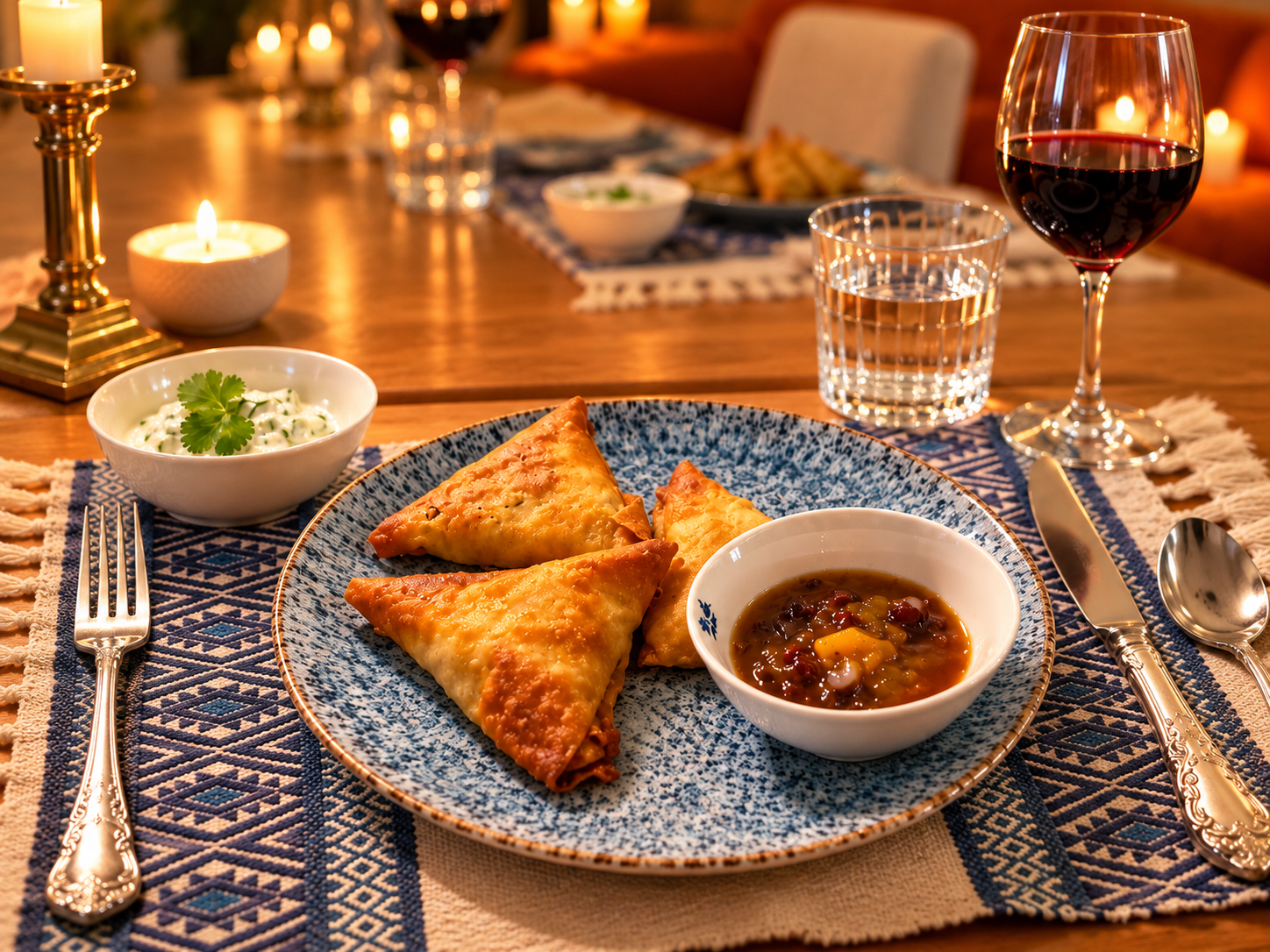
Served hot and crisp with a small portion of mango chutney on the side, they make a great starter or appetizer.
Baked mini vegetable samosas
Yield: about 10–12 mini samosas
Serves: 2 as a generous starter or 4 as an appetizer
Difficulty: medium
Preparation: about 25 minutes
Baking: 15–18 minutes
Total time: about 45 minutes
Ingredients
- 3–4 large sheets filo pastry, yufka, samosa pastry, or thin spring roll pastry, depending on size
- 150 g potato
- 70 g frozen peas
- 40 g onion
- ½ tsp ground cumin
- ¼ tsp turmeric
- ¼ tsp Garam Masala
- 1 pinch chili, optional
- About ½ tsp salt
- Black pepper to taste
- 1 tsp lemon juice
- 1 tbsp oil
- A little extra oil for brushing
- Homemade mango chutney, to serve
Which pastry should you use, and where can you find it?
Filo pastry / phyllo dough
This is the easiest option to recommend internationally. It is very thin and bakes up light and crisp.
- Germany: Filoteig or Filo-Teig.
- Latin America: masa filo, pasta filo, or phyllo dough.
- United States: phyllo dough or filo dough.
- United Kingdom: filo pastry.
It is usually found in larger supermarkets in the chilled or frozen section, as well as Mediterranean, Greek, Turkish, or international grocery stores.
Yufka / Yufka-Teig
Yufka is slightly thicker and more flexible than filo, which makes it easier to fold and less likely to tear.
- Germany: Yufka-Teig or Yufkablätter, especially in Turkish supermarkets.
- Latin America: less common, usually in Turkish or Middle Eastern specialty stores.
- United States: Turkish yufka or yufka sheets.
- United Kingdom: yufka pastry or yufka sheets.
If you cannot find it, filo pastry works perfectly well.
Samosa pastry
If available, this is an excellent option. It may be sold as:
- Samosa pastry
- Samosa sheets
- Samosa patti
- Samosa wrappers
In the US and UK it is often found in Indian, Pakistani, Asian, or international grocery stores. In Latin America, check Asian or imported-food shops.
Spring roll pastry
Thin and flexible spring roll wrappers can also work well. They are not exactly the same as samosa pastry, but they produce crisp triangles.
Puff pastry
Puff pastry can be used as a last resort, but the result will be much thicker, richer, and less similar to a traditional samosa.
My recommendation: filo pastry first, then samosa pastry, thin spring roll pastry, or yufka. Use puff pastry only as a backup.
Before you start
Filo pastry dries out very quickly. Keep the sheets you are not using covered with a clean, slightly damp kitchen towel.
The exact number of sheets depends on their size. The important thing is to cut strips about 8–10 cm wide and use all the filling.
Step-by-step preparation
1. Cook the potato
Peel the potato and cut it into small cubes. Cook in lightly salted water for 8–10 minutes, until tender but not falling apart. Drain well and set aside.
2. Cook the onion and spices
Heat 1 tbsp oil in a frying pan. Add the 40 g finely chopped onion and cook over medium heat for 3–4 minutes, until softened.
Add cumin, turmeric, Garam Masala, and chili if using. Cook for about 30 seconds, stirring, until fragrant.
3. Add the potato and peas
Add the cooked potato, 70 g peas, salt, and black pepper. Cook for 3–4 minutes.
Lightly mash some of the potato with a spatula, leaving some pieces whole. The filling should hold together without becoming a purée.
4. Finish the filling
Add 1 tsp lemon juice. Mix, taste, and adjust the salt if necessary. Remove from the heat and let the filling cool slightly before shaping the samosas.
How to shape the mini samosas
Cut the pastry into strips about 8–10 cm wide.
Brush each strip very lightly with oil. Place about 1 tbsp filling at one end.
Fold into a triangle, then continue folding the strip over itself in a triangle until you reach the end.
Repeat until all the filling is used. Depending on the size of the strips and how much filling you use, you should get about 10–12 mini samosas.
Do not overfill them, or they may split open while baking.
Baking
Preheat the oven to 185°C fan or 200°C conventional.
Place the samosas on a baking tray lined with baking paper. Brush very lightly with oil.
Bake for 15–18 minutes, until golden and crisp.
How to serve them
I serve them straight from the oven with homemade mango chutney in a small bowl on the side.
This keeps the samosas crisp and lets everyone add as much chutney as they like.
The recipe makes about 12 mini samosas. For two people, serve 3–4 per person as a starter and save the rest, or serve them as an appetizer for four.
The perfect accompaniment: homemade mango chutney
These samosas were one of the first ways we used the mango chutney I had made earlier that day.
The contrast works especially well: a hot, crisp samosa, soft spiced filling, and fruity, sweet-tangy chutney.
See the homemade mango chutney recipe
Tips from my kitchen
- Do not overfill the samosas.
- Keep filo pastry covered while you work.
- If the filling is too hot, the pastry can become soft or tear.
- The filling can be prepared ahead and refrigerated.
- Mango chutney can be served cold or slightly tempered.
- Baking is a lighter alternative to frying.
Mi cocina entre mundos
Samosas are part of South Asian cuisine and exist in many different versions.
This recipe is not intended to be a strictly traditional version. It is a simple adaptation for a home dinner, using accessible ingredients and baking instead of frying.
That is exactly the idea behind Mi cocina entre mundos: taking a familiar preparation, understanding what makes it special, and adapting it without losing its essence.