Asturian Fabada: Traditional Spanish Bean Stew, Step by Step
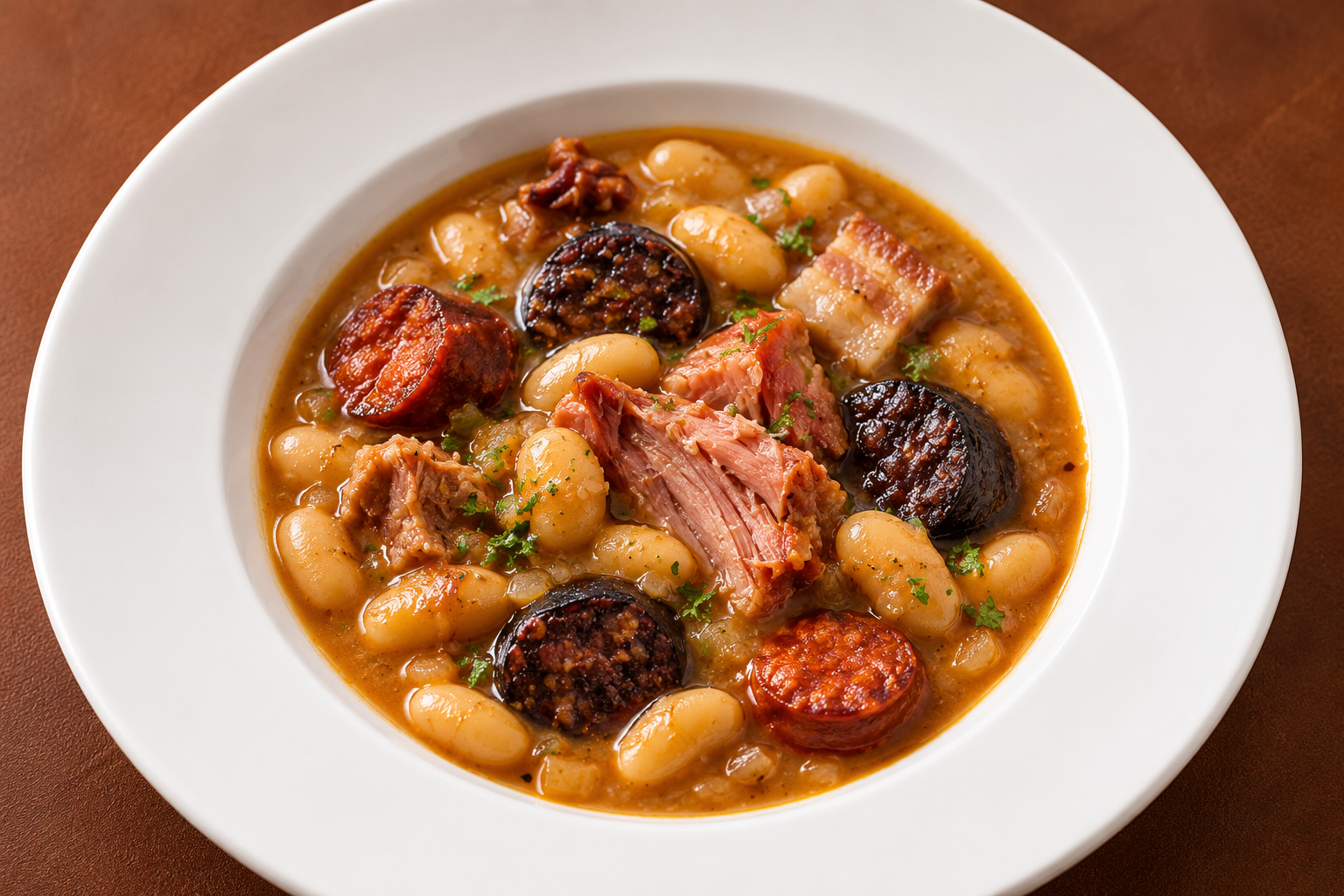
Asturian fabada is a classic Spanish bean stew with tender white beans, chorizo, morcilla, pork belly and cured ham bone. I tested two alternative cooking methods: a pressure cooker and Thermomix®. Choose one; you do not need both.
My experience: the pressure cooker and Thermomix® with a blade cover produced very similar results. I did not use a blade cover in the Thermomix® test, and the beans broke down almost into a purée. A compatible blade cover is essential for my slow-cooking adaptation; I subsequently tested the recipe with the compatible blade cover and the beans stayed intact, with a result almost as good as the pressure-cooked batch.
Recipe at a glance
About 4 generous servings; 20 minutes preparation; 10–12 hours soaking; cooking time depends on the chosen method.
Ingredients
- 500 g dried Asturian fabes or large dried white beans
- 200 g fresh pork belly
- 1 peeled onion
- 2 Asturian chorizo sausages
- 2 Asturian morcilla (blood sausages)
- 1 bone from a cured Serrano ham leg
- 1 garlic clove (optional)
- Water as needed and salt to taste
The ham bone is the bone left from a leg of Serrano or similar dry-cured ham, ideally with some meat and fat attached. Have it cut into manageable pieces without splinters.
Before cooking
- Soak the dried beans in plenty of cold water for 10–12 hours, then drain.
- For this adaptation, we boiled the soaked beans in fresh water for 15 minutes and drained them again. This preliminary boil is not essential to every traditional fabada recipe.
- Keep the morcilla aside until the final stage.
Method 1: pressure cooker
- Put beans, pork belly, chorizo, onion and ham bone in the cooker. Add garlic if using.
- Add water to cover by approximately 2–3 cm, without exceeding the manufacturer’s maximum fill level for beans.
- Bring to operating pressure and cook for approximately 25–35 minutes, adjusting to the cooker and bean variety.
- Allow pressure to release naturally; open only when safe. Check that the beans are fully tender, and cook longer if needed.
- Add the morcilla and simmer gently without pressure until fully cooked and heated through.
- Season with salt only after tasting. Rest for about 30 minutes before serving.
Method 2: Thermomix® with blade cover
Important: without a blade cover, our beans broke apart. Use the compatible blade cover and the Slow Cooking mode according to the appliance instructions. I also tested this recipe with the cover fitted, and the beans held their shape almost as well as in the pressure cooker.
- Fit the blade cover according to the manufacturer’s instructions.
- Add only as much soaked beans, meat and water as safely fits within the appliance and Slow Cooking mode limits. The full 500 g of dried beans may require several batches.
- Use the Slow Cooking mode and the permitted temperature and duration settings for your model. Check that the beans are completely cooked.
- Cook the morcilla separately in a little broth at a gentle simmer until fully cooked; add carefully at the end.
- Rest and adjust seasoning.
Reverse blade rotation and spoon speed alone did not protect the beans in our trial.
Finding ingredients outside Spain
Guatemala and Latin America
In Guatemala, look for frijoles blancos or piloyes blancos. These are not necessarily identical to Asturian fabes, but large creamy varieties can substitute. Elsewhere, look for porotos blancos, alubias blancas or large white beans. Spanish cured or smoked chorizo and Spanish morcilla are closest to the original; use fresh unsmoked pork belly.
United States
Search for Asturian fabes, fabada beans, large dried white beans, Spanish chorizo, Spanish morcilla, fresh pork belly and Spanish cured ham bone. Fresh Mexican chorizo has a different flavour.
United Kingdom
Look for Asturian fabes or large dried white beans, Asturian chorizo, Spanish morcilla, pork belly and a Spanish cured ham bone at specialist Spanish food shops.
Germany
Find fabes at Spanish grocers or substitute dried große weiße Bohnen or Butterbohnen. Look for frischer Schweinebauch (unsmoked) and specialist Spanish suppliers for the chorizo, morcilla and ham bone.
A compango asturiano pack may contain the characteristic chorizo, morcilla and pork belly; check the contents.
Tips and what I learned
Avoid stirring the beans unnecessarily. Add the morcilla towards the end so it stays intact. Taste before adding salt: the cured meats are already salty. Mash a few cooked beans into the broth if it needs thickening. Refrigerate leftovers promptly.
I kept the two trial batches separate: the Thermomix® beans had broken down, whereas the pressure-cooked beans retained their shape. Both the pressure cooker and Thermomix® with a blade cover gave very similar, satisfying results. At Mi cocina entre mundos, we share not only recipes but what really happens in our kitchen.