Creamy Macaroni Carbonara with Bacon
This is not intended to be a traditional Roman carbonara. It is a creamy, practical version for two, adapted to the ingredients I had at home and to the Thermomix®.
It includes onion, cream and bacon, ingredients that are not part of classic Italian carbonara. That is why I prefer to describe it for what it really is: a creamy pasta inspired by carbonara, easy to prepare for an everyday dinner.
The story behind this recipe
Some dishes immediately bring a very specific recipe to mind, and carbonara is probably one of them. But this recipe found its way into my kitchen by a different route.
The original idea was to make a quick carbonara-style macaroni dish for two. As I cooked it, I realized that rather than trying to reproduce traditional Roman carbonara, it was more interesting to accept this preparation for what it is: a homemade, creamy and very practical version made with onion, bacon, cream, Parmesan and egg yolk.
During the preparation, a very ordinary situation came up: the pasta was almost ready, but there were still about twenty minutes before I could serve it. Because I had not yet added the egg yolk, I was able to wait and finish the sauce just before bringing it to the table. That small inconvenience ended up becoming one of the most useful tips in the recipe.
Language also plays a part. What is commonly called bacon in Spain is often known as tocino in many Latin American countries; in Germany you will see names such as Baconwürfel or Speckwürfel, while in the United Kingdom streaky bacon is the closest choice. So even a seemingly simple recipe ends up travelling between languages and markets.
That is exactly why it belongs in Mi Cocina entre Mundos: the point is not to present an “authentic” carbonara, but to show how a familiar idea changes when we actually cook it at home, using the ingredients available to us and adapting it to our own circumstances.
This version does not replace traditional Italian carbonara. It is simply another story that grew from it.
Ingredients — serves 2
- 180 g macaroni
- 60 g onion
- 20 g extra-virgin olive oil
- 100 g bacon, cut into strips or small pieces
- 110 g cooking cream
- 260 g water
- 1 egg yolk
- 35–40 g grated Parmesan
- ¼ tsp salt, then adjust to taste
- Freshly ground black pepper to taste
- 1 tbsp fresh chopped parsley
Finding the ingredients in different countries
Spain: look for bacon, nata para cocinar and queso parmesano.
Latin America: bacon is often sold as tocino or tocino ahumado. Cooking cream may be labelled crema de leche or crema para cocinar, depending on the country.
Germany: look for Baconwürfel or Speckwürfel, Kochsahne, Parmesan, Eigelb and Petersilie.
United States: use bacon, heavy cream or heavy whipping cream, Parmesan cheese, egg yolk and fresh parsley. Choose regular bacon rather than Canadian bacon.
United Kingdom: look for streaky bacon, single cream or another cream suitable for cooking, Parmesan, egg yolk and flat-leaf parsley. Streaky bacon is closer to the bacon used here than back bacon.
You do not need to find exactly the same package or product name I used. The important thing is to identify the local equivalent and adapt the recipe to what is actually available where you live.
Step-by-step preparation with Thermomix®
1. Prepare the onion
Add 60 g onion and 20 g olive oil to the mixing bowl. Chop 4 sec / speed 5. Scrape down the sides.
2. Cook the bacon
Add 100 g bacon and cook 8 min / 120°C / reverse / spoon speed.
3. Cook the macaroni
Add the cream, water, macaroni, salt and black pepper. Cook 10 min / 100°C / reverse / spoon speed. The exact time may need a small adjustment depending on the pasta; it should still retain a little bite before the final step.
4. Add the egg yolk and Parmesan
Add 1 egg yolk and about 20 g grated Parmesan. Cook 1 min 30 sec / 90°C / reverse / spoon speed. The aim is to incorporate the yolk for creaminess without scrambling it.
5. Rest and serve
Leave to rest in the mixing bowl for about 2 minutes. Check the consistency and adjust salt and pepper. If the sauce has become too thick, loosen it with a small amount of hot water.
If you are not serving immediately
If you need to wait about 20 minutes, it is best to do so before adding the egg yolk. Cook the pasta slightly less and leave a little more liquid. If necessary, add 20–30 g hot water to maintain the creamy texture. Keep it covered and finish with the yolk and Parmesan shortly before serving. Once the yolk has been added, avoid holding the pasta at a high temperature for long.
Serving
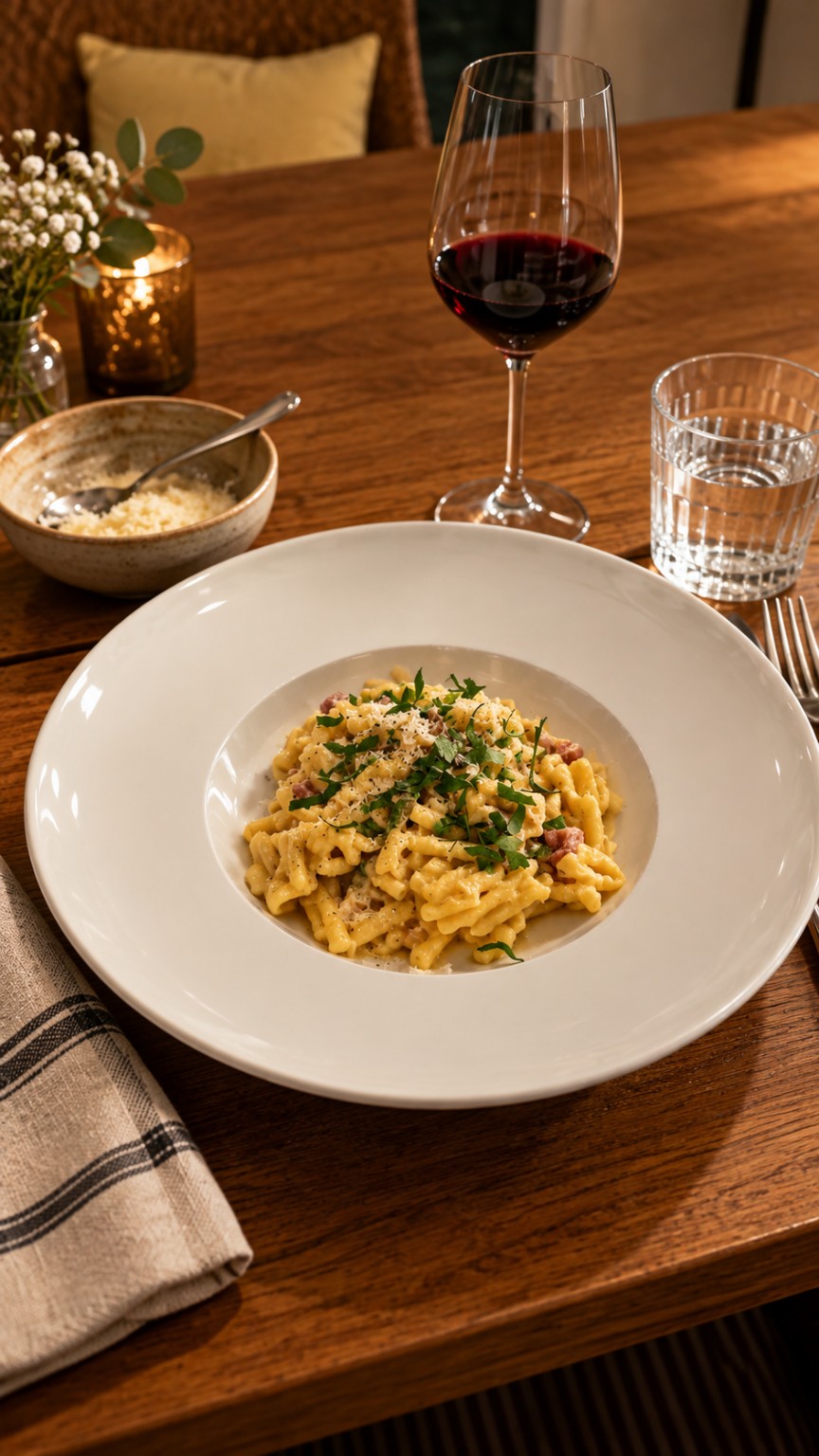
Serve immediately in a wide, deep bowl and finish with the remaining freshly grated Parmesan, freshly ground black pepper and chopped fresh parsley.
What I learned making this recipe
The key is not adding more ingredients but controlling when the egg yolk goes in and avoiding excessive heat. It also reflects the approach behind Mi Cocina entre Mundos: start with an idea, actually cook it at home, and then document the small adjustments that worked.
This is a carbonara-inspired version, not a traditional Italian carbonara.